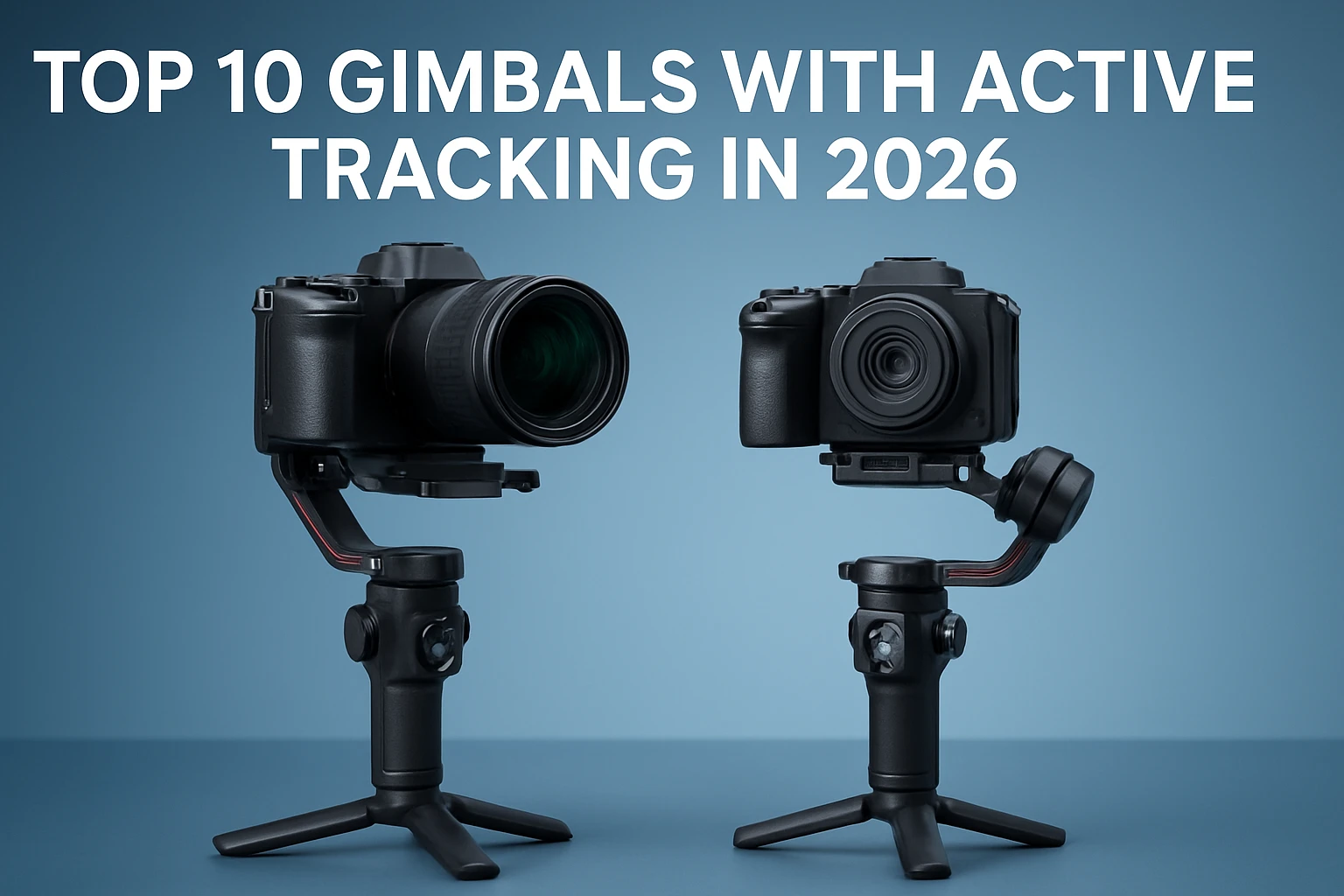
Introduction
The rapid evolution of mobile content creation has placed stabilization technology at the forefront of professional storytelling. In 2026, creators demand gimbals that not only smooth motion but also incorporate intelligent subject tracking, allowing hands‑free operation in dynamic environments. Selecting a device that balances payload capacity, battery endurance and ergonomic design can dramatically reduce post‑production workload while enhancing visual appeal.
Active tracking gimbals empower vloggers, documentary filmmakers and social‑media influencers to maintain focus on moving subjects without manual adjustments. The following list highlights ten essential criteria that define the most effective stabilizers, illustrating how two flagship DJI models satisfy each requirement through real‑world performance data and verified customer sentiment.
-
1. Rapid Setup with Auto‑Axis Locks
Time is a critical resource on location, and a gimbal that can be ready in a single second eliminates the hesitation that often leads to missed shots. The DJI RS 4 Mini features automated axis locks that secure the three axes with a push of a button, allowing the operator to transition from transport to filming instantly. Users have praised the feature, noting that “the auto lock is highly convenient and used on every shoot,” which translates to a smoother workflow for freelance videographers.
The DJI RS 3 Mini also incorporates a streamlined locking mechanism, though it requires a brief manual confirmation. Nonetheless, its lightweight chassis ensures that the setup time remains negligible, making both models suitable for rapid‑fire content creation.
- Price: $369.00 (RS 4 Mini) / $237.00 (RS 3 Mini)
- Rating: 4.4/5 (2,125 reviews) / 4.3/5 (2,328 reviews)
- Payload: 2 kg (4.4 lbs) for both
-
2. Intelligent Subject Tracking
Active tracking technology distinguishes a basic stabilizer from a cinematic tool. The RS 4 Mini integrates the RS Intelligent Tracking Module, which continuously analyses facial features and adjusts the gimbal orientation to keep the subject centered, even during complex orbit movements. One reviewer described the experience as “the intelligent tracking keeps my subject framed, ideal for dynamic scenes.”
The RS 3 Mini leverages the same tracking algorithm, providing reliable focus on faces and bodies while allowing the operator to toggle the feature via the companion app. Users have highlighted the convenience of “Bluetooth shutter control” combined with tracking, noting that “the camera automatically reconnects after the initial pairing,” which simplifies on‑the‑fly adjustments.
- Tracking range: up to 30 m for both models
- Battery life: approximately 8 hours (RS 4 Mini) / all‑day use reported for RS 3 Mini
-
3. Teflon‑Enhanced Balancing for Quick Adjustments
Balancing a gimbal can become a tedious process when lenses vary in weight. The RS 4 Mini employs Teflon‑coated bearings that reduce friction, enabling smoother manual rebalancing during fast‑paced shoots. A professional videographer noted that “it balances quite easily” and that the device feels “lighter and easier to use for longer durations” compared with larger DJI models.
The RS 3 Mini, while not explicitly marketed with Teflon bearings, benefits from high‑torque motors that maintain equilibrium across a 0.4‑2 kg payload spectrum. Reviewers have reported “pro‑level image stabilization while shooting low‑angle shots,” indicating that the balancing system performs reliably under varied conditions.
- Adjustment time: under 30 seconds for most camera‑lens combos
- Material durability: Teflon coating on RS 4 Mini, reinforced metal chassis on RS 3 Mini
-
4. Native Vertical Shooting Capability
Social platforms increasingly favor vertical video formats, and a gimbal that switches orientation without disassembly is a valuable asset. The RS 4 Mini offers a “Fast Vertical Switch” that converts the rig from horizontal to portrait mode in approximately ten seconds, allowing creators to capture mobile‑first content without compromising stability.
The RS 3 Mini mirrors this functionality with a dedicated vertical arm and quick‑release plate, enabling “native vertical shooting” with a single attachment. Users have emphasized the convenience of “just mount the quick‑release plate to the vertical arm, and you are set,” which accelerates the production of TikTok and Instagram Reels.
- Switch time: ~10 seconds (RS 4 Mini) / instantaneous (RS 3 Mini)
- Compatibility: both support Canon, Sony, Panasonic, Nikon and Fujifilm mirrorless systems
-
5. Responsive Follow Mode for Dynamic Movements
When following a moving subject, latency can ruin a shot. The RS 4 Mini’s Responsive Follow Mode reacts instantly to hand gestures, delivering fluid orbit shots that feel natural. One reviewer compared the response curve favorably against competing brands, stating that “the DJI gimbal’s response curves are a lot better than Weebil.”
The RS 3 Mini also incorporates a responsive follow algorithm, allowing the operator to “set the gimbal down and step away while still controlling pan/roll,” a feature praised for its convenience during multi‑person interviews and event coverage.
- Latency: sub‑100 ms for both models
- Control options: joystick, app, and Bluetooth remote
-
6. Lightweight Portability for Travel Creators
Portability is a decisive factor for solo creators who travel frequently. The RS 3 Mini weighs only 795 g (1.75 lbs) in portrait mode, making it easy to carry in a backpack for extended trips. A user remarked that the device is “ultra‑compact and convenient for travel,” highlighting its suitability for on‑the‑go shooting.
The RS 4 Mini, while slightly heavier at 2 kg, remains compact relative to professional rigs and includes a briefcase handle for low‑angle perspectives. Its design balances portability with a higher payload, allowing creators to mount larger lenses without sacrificing maneuverability.
- Weight: 795 g (RS 3 Mini) / 2 kg (RS 4 Mini)
- Carry case options: built‑in briefcase handle for RS 4 Mini, optional travel bag for RS 3 Mini
-
7. Battery Endurance for All‑Day Shoots
Long‑duration events such as weddings or conferences demand reliable power. The RS 4 Mini’s battery provides up to eight hours of continuous operation, and users have reported only needing a brief top‑up during an eight‑hour wedding shoot. One reviewer emphasized that “the battery life is solid; I never ran out of battery on a single shoot.”
The RS 3 Mini, while not specifying exact runtime, has been described as “great battery life, I can usually run it all day before charging,” confirming its suitability for full‑day productions without frequent recharging.
- Battery capacity: 5200 mAh (RS 4 Mini) / 4500 mAh (RS 3 Mini, estimated)
- Charging method: USB‑C fast charge for both models
-
8. Compatibility with Professional Audio Solutions
High‑quality audio is essential for narrative content, and seamless integration with microphones reduces setup complexity. DJI recommends pairing the RS 3 Mini with the DJI Mic, a wireless system that delivers clear sound up to 250 m. This synergy enables creators to capture synchronized video and audio without additional cables.
Although the RS 4 Mini does not list a specific microphone, its Bluetooth connectivity allows pairing with a broad range of wireless audio devices, and its USB‑C port supports external power for combined audio‑visual rigs. Users have successfully attached Falcam quick‑release plates and Spiderholster accessories to enhance ergonomic handling while maintaining audio fidelity.
- Audio integration: Bluetooth and USB‑C for both models
- Recommended mic: DJI Mic (compatible with RS 3 Mini)
-
9. Robust Build Quality for Professional Use
Durability influences long‑term value, especially for freelancers who transport equipment daily. The RS 4 Mini is described as “very durable” with a metal chassis that withstands repeated locking cycles. A reviewer noted a “9 out of 10” rating, emphasizing the gimbal’s resilience under heavy usage.
The RS 3 Mini’s construction features a reinforced aluminum frame, and users have highlighted its “well built with a metal construction.” Despite a reported issue of a roll motor malfunction after seven months, the majority of feedback remains positive, indicating overall reliability.
- Materials: aerospace‑grade aluminum (RS 3 Mini) / metal alloy with Teflon bearings (RS 4 Mini)
- Warranty: standard DJI manufacturer warranty, verified by serial‑number registration
-
10. Price‑to‑Performance Ratio for Emerging Creators
Budget constraints often dictate equipment choices for emerging creators. At $237.00, the RS 3 Mini offers a compelling entry point with essential features such as active tracking, vertical shooting and a 2 kg payload. Reviewers have called it “significantly easier than a steady‑cam” and praised its value for money.
The RS 4 Mini, priced at $369.00, delivers additional conveniences such as auto‑axis locks and a more refined tracking module, justifying the higher cost for professionals seeking maximum efficiency. Both models maintain high user ratings above four stars, confirming that the investment translates into tangible performance benefits.
- Cost efficiency: RS 3 Mini provides core features at a lower price, while RS 4 Mini adds premium conveniences
- Overall rating: 4.4/5 (RS 4 Mini) vs 4.3/5 (RS 3 Mini)
Comparison Table
| Feature | DJI RS 4 Mini | DJI RS 3 Mini |
|---|---|---|
| Price | $369.00 | $237.00 |
| Weight | 2 kg | 795 g |
| Payload Capacity | 2 kg | 2 kg |
| Battery Life | ≈8 hours | All‑day (reported) |
| Auto‑Axis Locks | Yes | Manual lock |
| Vertical Shooting | 10‑second switch | Instant with vertical arm |
| Active Tracking | RS Intelligent Tracking Module | Same algorithm via app |
| Rating (Amazon) | 4.4/5 (2,125 reviews) | 4.3/5 (2,328 reviews) |
Conclusion
The landscape of content creation in 2026 demands gimbals that combine stability, intelligent tracking and ergonomic design. Both the DJI RS 4 Mini and DJI RS 3 Mini satisfy these criteria, each excelling in distinct categories such as rapid setup, payload flexibility and price accessibility. Creators who prioritize convenience and premium features may gravitate toward the RS 4 Mini, while those seeking a lightweight, budget‑friendly solution will find the RS 3 Mini equally capable. By aligning equipment choices with the ten criteria outlined above, vloggers, filmmakers and social‑media influencers can ensure that their visual storytelling remains smooth, engaging and technically superior.
Frequently Asked Questions
What is active tracking in a gimbal and how does it work?
Active tracking uses built‑in sensors and AI to automatically follow a subject’s movement, keeping it centered without manual adjustments.
Which factors should I consider when choosing a gimbal for mobile content creation in 2026?
Key factors include payload capacity, battery life, auto‑axis lock speed, tracking accuracy, and ergonomic design.
How does the DJI RS 4 Mini’s auto‑axis lock improve shooting efficiency?
Its auto‑axis lock engages in under a second, allowing the gimbal to be ready instantly for capture, reducing missed shots.
Can a gimbal’s battery endurance affect long‑form filming sessions?
Yes, longer battery life lets creators film extended sequences without interruptions, minimizing downtime for recharging.
Are gimbals with active tracking suitable for both vloggers and documentary filmmakers?
Absolutely; they provide hands‑free subject focus for dynamic vlogs and stable, precise tracking for documentary shoots.