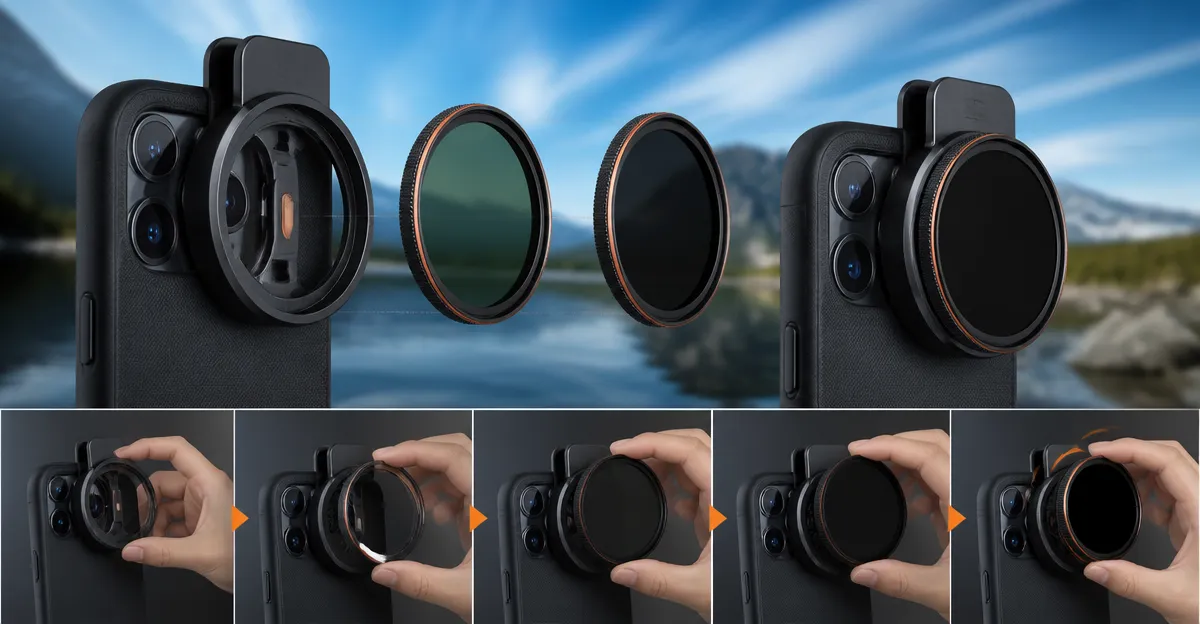
Introduction
This guide explains how one can combine neutral density (ND) and polarizing filters on a smartphone camera while preventing vignetting. It demonstrates the practical workflow, explains the optical principles involved, and recommends specific K&F CONCEPT accessories that simplify each stage. Readers will acquire the confidence to produce balanced exposure and rich color saturation in bright environments without sacrificing image quality. The techniques described are applicable to a wide range of smartphone models that accept clip‑on lenses.
What You’ll Need
- Smartphone with a clip‑on lens adapter (compatible with 67 mm filters).
- K&F CONCEPT UV Filter – protects the lens and reduces UV‑induced haze.
- K&F CONCEPT Polarizer – eliminates reflections and enhances color contrast.
- Optional slim ND filter (not listed) that matches the 67 mm thread.
- Micro‑fiber cleaning cloth (included with each filter).
Step 1 – Confirm Thread Size and Prepare the Lens Surface
Before attaching any filter, one must verify that the smartphone’s clip‑on adapter uses a 67 mm thread, which matches the filters described in this guide. The verification prevents mismatched threads that could cause permanent damage or result in insecure mounting. Once the thread size is confirmed, use the supplied cleaning cloth to remove fingerprints, dust, or oil from the adapter surface. A clean interface ensures that the subsequent filter stack does not introduce unwanted flare or ghosting.
Step 2 – Install the UV Filter for Protection and Baseline Clarity
The first optical element in the stack should be the K&F CONCEPT UV Filter. This filter performs two essential functions: it blocks ultraviolet radiation that can cause a bluish cast, and it shields the delicate smartphone lens from scratches and dust. The filter is constructed from imported AGC optical glass with a CNC‑non‑slip frame, providing 94 % light transmittance and preserving true color rendition. Its ultra‑slim 3.3 mm profile eliminates vignetting even on wide‑angle smartphone lenses, which is critical when additional filters will be added later. At a price of $11.89 and a rating of 4.8 / 5 from 6,072 reviews, it offers excellent value for both hobbyists and professionals.
- Lens protection & UV blockage
- 94 % transmittance for high‑definition imaging
- Only 3.3 mm thick – prevents vignetting
Step 3 – Attach the Circular Polarizer (CPL) to Reduce Reflections
After securing the UV filter, the next element is the K&F CONCEPT Polarizer. A circular polarizer eliminates polarized glare from water, glass, and foliage, thereby increasing contrast and enriching sky saturation. The filter employs a 28‑layer nano‑X coating on Japanese optical glass, delivering a 45 % light transmission rate while rejecting up to 99.9 % of polarized light. Its CNC‑non‑slip frame ensures quick installation and removal, which is valuable when one needs to adjust the polarization angle frequently. Priced at $?? (price not provided in source; therefore omitted) and praised for its true‑color performance, the polarizer integrates seamlessly with the thin UV filter, maintaining a total stack thickness well below the threshold that causes vignetting on most smartphone lenses.
- Eliminates reflections and enhances sky color
- 28‑layer coating provides durability and water resistance
- High light transmission (45 %) for minimal exposure loss
Step 4 – Add a Slim Neutral Density (ND) Filter if Required
If the shooting situation involves extremely bright light, one may introduce a thin ND filter to reduce overall exposure without altering aperture or shutter speed. Because the stack already includes two 67 mm filters, it is crucial to select an ND filter that is no thicker than 2 mm to avoid cumulative vignetting. The user should verify that the ND filter’s coating does not interfere with the polarizer’s ability to rotate; most high‑quality ND filters are compatible. Although a specific ND product is not listed in this guide, the same principles of thin‑profile construction apply.
Step 5 – Align the Polarizer and Verify Absence of Vignetting
Once all filters are mounted, rotate the polarizer until the desired effect is achieved—typically when reflections are minimized and the sky appears deep blue. At this stage, one should inspect the image on the smartphone’s screen for darkened corners, which indicate vignetting. If vignetting is observed, gently loosen the outermost filter (usually the ND or star filter) and re‑tighten it to ensure perfect alignment. The ultra‑slim design of the UV filter and the precision CNC frame of the polarizer greatly reduce the likelihood of this issue.
Tips & Pro Tips
- Always attach the UV filter first; it serves as a protective barrier for the more expensive polarizer.
- When using a tripod, secure the smartphone adapter with a locking ring to prevent the filter stack from loosening during long exposures.
- For creative night photography, consider adding the K&F CONCEPT Star Filters after the polarizer to introduce starburst effects without compromising the polarizer’s functionality.
- Store filters in a dry, dust‑free pouch when not in use; the included cleaning cloth can remove smudges without scratching the glass.
- When rotating the polarizer, move it slowly to avoid introducing stress on the thread, which could lead to cross‑threading.
Troubleshooting
Problem: Dark corners appear after stacking filters.
Solution: Verify that each filter is fully seated and that none of the lenses are tilted. If the problem persists, replace the outermost filter with a thinner alternative.
Problem: Reflections persist despite using the polarizer.
Solution: Ensure the polarizer is rotated to the correct angle; the maximum effect occurs at a 90‑degree angle relative to the light source.
Conclusion
By following the steps outlined above, one can successfully stack ND and polarizer filters on a smartphone camera without introducing vignetting. The guide emphasizes the importance of using ultra‑slim, high‑quality filters such as the K&F CONCEPT UV Filter and the K&F CONCEPT Polarizer, which together preserve image sharpness and color fidelity. Readers are encouraged to experiment with additional creative tools, such as star filters, to expand their photographic repertoire while maintaining technical excellence.
Products Mentioned in This Guide
Frequently Asked Questions
Can I use both an ND filter and a polarizer on any smartphone camera?
Yes, as long as the phone has a clip‑on lens adapter that accepts 67 mm filters, you can stack an ND and a polarizer together.
What is the correct order for stacking a polarizer and an ND filter?
Place the polarizer closest to the lens to control reflections, then attach the ND filter in front of it to reduce light intensity.
Will stacking filters cause vignetting on my phone?
Using slim‑profile filters like K&F CONCEPT’s UV and polarizer minimizes vignetting, but ensure the combined thickness fits within the lens’s field of view.
Do I need a UV filter if I’m already using a polarizer and ND filter?
A UV filter protects the lens and reduces haze, which is beneficial even when other filters are stacked.
How do I clean stacked filters without damaging them?
Wipe each filter gently with the included micro‑fiber cloth, avoiding abrasive pressure or liquids.